
In the context of increasingly severe air pollution, gas scrubbers have become an effective solution for treating industrial emissions by removing dust, chemical vapors, and harmful gases before releasing them into the environment. Thanks to their high treatment efficiency, these devices are widely applied across many industries. Let’s explore more with Tan Thanh.
1. Understanding Gas Scrubbers
A gas scrubber is an important device in industrial dust and gas treatment systems that effectively removes dust particles and impurities in the air. This device operates based on the principle of contact between the dust-laden gas stream and a liquid (water or chemical solution), whereby dust particles are trapped and separated from the gas flow.
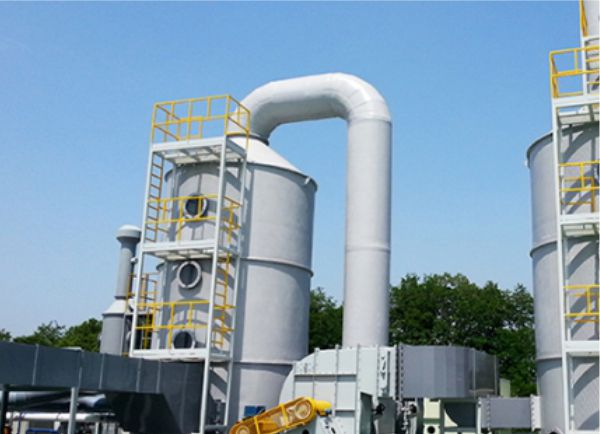
Structurally, gas scrubbers usually have a cylindrical or rectangular shape, containing a packing layer made of metal, ceramic, or plastic materials to increase the contact area between gas and liquid. When the gas passes through, dust particles adhere to the packing surface and are washed away by water, eventually collected as sludge.
Besides removing dust, gas scrubbers also treat gas molecules, preventing them from escaping into the environment. Therefore, this device becomes an effective solution widely applied in factories and plants with large emission volumes.
2. Operating Principle of Gas Scrubbers
The dust-containing gas stream is drawn into the scrubber from the bottom by a fan, while the absorbing liquid is sprayed from the top downward, creating an effective contact environment. As the exhaust gas passes through, pollutants are retained by dissolution or chemical reaction mechanisms, allowing clean gas to exit, while solid residues are flushed away by water and periodically discharged.
Absorption mechanism of gas scrubbers:
- Chemical absorbents: Transform the chemical composition of exhaust gases into other substances that can be removed. For example, lime water absorbs SO₂ and CO₂.
- Physical absorbents: Simply dissolve gases without changing their chemical composition, commonly using water or heavy oil.
3. Advantages and Disadvantages of Gas Scrubbers
Advantages:
- High filtration efficiency: Gas scrubbers can remove over 90% of pollutants soluble in water, significantly improving air quality.
- Energy-saving: These devices consume less electricity, reducing operational costs compared to other treatment systems.
- Simple operation and maintenance: Thanks to optimized design, gas scrubbers are easy to install, operate, and maintain, saving time and effort.
- Efficient water distribution: Optimized water distribution mechanisms ensure stable and effective gas treatment.
Disadvantages:
- Wastewater and sludge generation: Dust filtration produces wastewater and sludge that require proper treatment, increasing operational costs.
- Risk of corrosion: Using water in the system can cause pipe and metal component corrosion, reducing equipment lifespan.
- Need for additional wastewater treatment: To operate effectively, enterprises must install wastewater treatment equipment, posing challenges for plants with limited space.
- Reduced pipe lifespan: Compared to other treatment methods, pipe components in gas scrubbers have lower durability and require periodic inspection and replacement.

4. Applications of Gas Scrubbers
Gas scrubbers are widely used across many industries to treat harmful emissions, reducing pollution and protecting the environment. Notable applications include:
- Boiler emission treatment: Remove pollutants generated from fuel combustion to control emission and dust levels.
- Acid vapor removal: Applied in metal cleaning and electrostatic painting lines to absorb and neutralize acid vapors, ensuring a safe working environment.
- Wastewater treatment plants: Support treatment of gases released during wastewater processing, controlling odors and toxic gases.
- Chlorine dosing systems: Used to absorb excess chlorine gas, minimizing pollution risks during water treatment.
- Casting and chemical preparation: Control toxic gas emissions in casting furnaces and chemical mixing processes, ensuring production safety.
5. Tan Thanh – Consultant and Installer of High-Performance Dust and Gas Treatment Systems
In the context of growing air pollution concerns, manufacturing businesses need high-quality dust and gas treatment systems to meet environmental standards and protect workers’ health. Tan Thanh proudly specializes in consulting, supplying, and installing optimal dust filtration solutions, ensuring superior performance for factories, production workshops, and industrial zones.
- Diverse dust treatment solutions: Central dust extraction, electrostatic dust filtration, fabric bag filters, etc., suitable for various industries.
- Advanced technology, high efficiency: Modern equipment guarantees over 99% fine dust removal, ensuring clean and safe air.
- Turnkey design and installation: Experienced experts advise and implement solutions tailored to each business.
- Cost-effective operation: Systems are optimized to minimize power consumption and maintenance costs, ensuring durable operation.
Using gas scrubbers is an important solution to help businesses control emissions, protect the environment, and improve production efficiency. Contact Tan Thanh now for the most suitable consultation.
- Hotline: 0917 531 007 – 0901 85 8686
- Email: kelvin@tatafilter.com
- Address: 50 Road No.1 Cu Xa Dien Luc, Truong Tho Ward, Thu Duc City, Ho Chi Minh City, Vietnam.
