Industrial Dust Collector Systems
Industrial Dust Collector Systems are essential for controlling dust and emissions in industrial production processes. They filter and remove dust particles, smoke, toxic gases, and other pollutants from the air stream. In industrial environments, dust collection and filtration systems are vital for protecting workers’ health and ensuring compliance with environmental regulations.
Common Types of Dust Collector Systems Used in Factories:
1. Inertial Separator (Primary Settling Chamber)
- Operates by changing the direction of airflow to separate large, heavy dust particles before entering fine filtration systems.
- Advantages: Simple design, low maintenance, cost-effective.
2. Cyclone Dust Collector
- Uses centrifugal force to separate dust from the air. Particles are thrown against the inner walls, lose kinetic energy, and fall into a hopper.
- Applications: Wood processing, grain milling, recycling, paper production.
- Can be used as a pre-filter before baghouse systems or combined with fabric filters in a hybrid design.
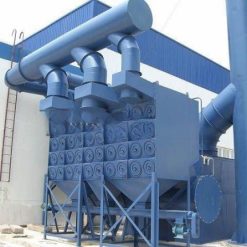
3. Baghouse Dust Collector
The most common system, using long fabric bags to trap dust as air passes through.
- Cleaning Methods: Mechanical shaking, reverse air, or pulse jet.
- Efficiency: Up to 99%.
- Industries: Cement, food, chemicals, metallurgy, incinerators.
- Advanced filter materials can handle hot gases, corrosive dust, acidic vapors, and hazardous pollutants like SOx, NOx, HCl.
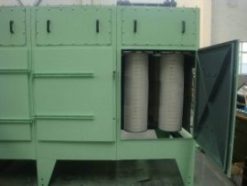
4. Cartridge Dust Collector
- Uses pleated filter cartridges to increase surface area.
- Advantages: Compact design, high efficiency for fine dust, welding fumes, pharmaceutical powders, paint dust.
- Can be modular for easy maintenance and combined with other pre-filtration systems.
5. Electrostatic Precipitator (ESP)
- Uses high-voltage electric fields to charge dust particles and collect them on electrodes.
- Efficiency: Very high (>99%).
- Applications: Coal-fired power plants, paper mills, cement factories.
- Requires skilled operation and regular maintenance.
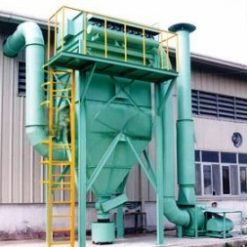
6. Modular Cyclone + Baghouse System
- Combines mechanical cyclone pre-filtration with fine filtration via baghouse.
- Reduces load on fabric filters, extends filter life, and lowers operating costs.
7. ESP Retrofit with Fabric Filters
- Converts old ESP systems by integrating fabric filters to improve efficiency.
- Cost-effective upgrade for older plants.
8. Explosion-Proof Modules
- Modern systems can be equipped with explosion prevention features: controller, pressure detectors, chemical suppression /chemical fire extinguishing tank, flame-free vents, and isolation valves.
9. Other Dust Collection Solutions
- Shaker Dust Collector: Uses mechanical shaking to clean filters.
- Downdraft Tables: Localized dust extraction from work surfaces.
- Absorption Scrubbers: Use liquid to neutralize and remove gaseous pollutants.
- Adsorption Scrubbers: Use materials like activated carbon to capture VOCs.
- Water Booths: Capture paint dust and volatile compounds using water curtains.
Choosing the Right Dust Collection System
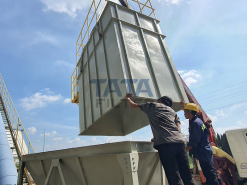
Selection depends on dust type, airflow volume, installation space, and environmental requirements. Tân Thanh designs and installs central dust collection systems tailored to each production line, including high-capacity fans, filters, cleaning mechanisms, hoods, and ductwork.
Modern systems feature automated control solutions using solenoid valves, differential pressure sensors, and programmable controllers. Leading automation providers offer integrated monitoring and control systems.

In the dust filtration industry, with prestigious capacity in the field of survey, consulting, design, construction, since 2010, Tan Thanh has participated in designing, manufacturing, installing many industrial dust filtration systems, industrial dust extraction systems, large-scale dust collection systems in the domestic market.

Comparison table of Industrial Dust Collector Systems:
| Dust Collection System | Operating Principle | Filtration Efficiency | Suitable Dust Type | Cost | Typical Applications |
|---|---|---|---|---|---|
| Primary Settling Chamber | Changes airflow direction to separate large dust particles | Low (~60–70%) | Coarse dust, large particles | Very low | Pre-treatment before fine filtration |
| Cyclone Separator | Uses centrifugal force to separate dust from airflow | Medium (~70–90%) | Dry dust, medium particles | Low | Woodworking, cement, recycling, grinding |
| Baghouse Filter | Air passes through fabric bags that trap dust | High (~99%) | Fine, dry dust | Medium | Cement, metallurgy, food processing, chemicals |
| Cartridge Filter | Pleated filter cartridges increase filtration surface area | High (~99%) | Fine dust, welding fumes, powders | Medium | Pharmaceuticals, welding, clean rooms |
| Electrostatic Precipitator (ESP) | Electrifies dust particles and attracts them to charged plates | Very high (>99%) | Fine dust, smoke | High | Power plants, metallurgy, chemical industries |
| Cyclone + Baghouse (Modular Combo) | Cyclone for pre-filtration, Baghouse for fine filtration | Very high (~99%) | Mixed dust | Medium | Manufacturing plants, upgraded systems |
| Retrofit ESP + Bag Filter | Converts ESP to bag filter to improve efficiency | Very high (~99%) | Fine dust, smoke | Medium | Older plants upgrading filtration systems |
Contact Us:
Please contact us directly so that Tan Thanh’s Team of Engineers and Managers can support and meet the specific dust treatment and dust collection requirements for each production line of the factory.
Hotline: 0901 858 686
Consulting Engineering Group:
- Nguyen Phuoc Thuan (Kelvin Nguyen). Phone: 0917 531 007. Email: kelvin@tatafilter.com
- Pham Thanh Binh. Phone: 0919823239. Email: thanhbinh@tatafilter.com