




The material of Antistatic Dust Filter Bag
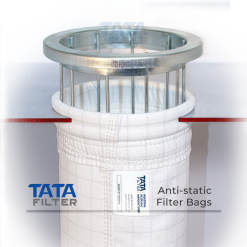
The basic material of dust filter bags is usually polymer-based plastic material that does not conduct electricity or dissipate electrical energy, while most types of dust and particles in industrial production have the ability to accumulate electric charge (static electricity), potentially posing a risk of fire and explosion caused by dust. Under such operating conditions, dust filters using fabric bags (including cartridge filters) use anti-static technology, by combining with anti-static fiber materials or anti-static agents, to dissipate the charge on the surface of the dust filter bag.
Anti-static fibers: There are many types of conductive fibers, of which the best and most widely applied fibers with many materials are stainless steel fibers. Conductive fibers have an additional structure in the form of stripes or woven into squares connected together, integrated into the core (scrim) of the filter fabric.
Antistatic for the entire surface: To ensure the entire surface of the filter material has antistatic ability, conductive fibers in the form of fibers (small, thin, short fibers) will be mixed with Polyester fibers in a certain ratio, during the process of making the filter fabric.
Antistatic technology for dust filter materials can be combined with different filter material processing technologies, applied to most types of non-woven fibers such as: Polyester, Acrylic, P84, PPS, Nomex, PTFE or material with “ePTFE” membrane.

Conductive and Antistatic
Conductive Filter Materials:
– Purpose: Conductive filters are designed to dissipate static electricity by allowing electric charges to flow through the material and be grounded.
– Composition: These filters often incorporate conductive fibers or filaments, such as carbon or metal, woven into the fabric, into parallel longitudinal fibers or a square. The larger the conductive fibers, or the greater the density of the quare net, the better the electrical conductivity and the lower the resistance.
Antistatic Filter Materials:
– Purpose: Antistatic filters aim to reduce the buildup of static electricity by making the surface of the material less likely to hold a charge.
– Composition: These filters can be treated with antistatic agents or have antistatic fibers blended into the base material, typically in small percentages (2-6%), the higher the fiber blend ratio, the higher the electrostatic dust filtration efficiency.
Testing – DIN 54345 part 5:
An independent testing laboratory in Germany tested samples of the same materials. The test results are shown below:
| Specimen (All are polyester felt) | Electrical Resistance (Ω) | Electrode Spacing (mm) | |
| Machine Direction | Cross-Machine Direction | ||
| Epitropic Polyester Fibers | 1.2 x 10⁷ | 5.4 x 10⁶ | 30 |
| Stainless Steel Fibers | < 1 x 10⁴ | < 1 x 10⁴ | 30 |
| Carbon-Filled ePTFE Fibers | 3.1 x 10⁷ | 1.4 x 10⁶ | 30 |
| Carbon-Filled ePTFE Fibers and ePTFE Membrane | 1.2 x 10⁷ | 1.2 x 10⁶ | 30 |
Conclusion: Stainless steel conductive fiber material has the lowest electrical resistance, showing the ability to conduct electricity (best) compared to the others in the table.
Reference: Article design test antistatic filters, W. L. Gore & Associate, 2001.
How to measure the surface resistance of anti-static materials:
The resistance of conductive materials is measured in Ohms (Ω), good conductors have low resistance, poor conductors have high resistance, insulators have extremely high resistance. The measurement indexes of the surface of anti-static materials can be quickly determined with a common handheld meter, according to the following levels:
– Conductive: 103 – 104 – 105 (Ω).
– Static dissipative: from 106, 107 … to 1011 (Ω).
– Insulation: 1012 (Ω).
Depending on the position of the meter in contact with the material surface, such as GUTSCHE Polyester fabric with its checkered conductive fiber structure, the resistance measurement can vary, up to <106 Ohm, meaning that GUTSCHE’s condutex® technology ensures good conductivity from 103 to <106 Ohm.

Main feature of Anti-static filter material
“Antistatic filter media is not only uesed for explosion prevention but also in order to ensure the highly efficient filtration of electrostatic rechargeable dust.” (Gutsche)
For the basic antistatic material is common Polyester fiber, refer to the scale provided by AOG as follows:

Antistatic filter fabric manufacturers

Manufactures like AOG and GUTSCHE developed their exclusive anti-static technologies, which are strictly tested and verified in the production process. They follow and achieve DIN 54345 part 1 và 5 standard.
GUSCHE’s special technology:
Condutex®: GUTSCHE’s anti-static technology complies with the ATEX 137, that requires plants to investigate explotion risk. Accredited according to DIN 54345 parts 1 and 5, GUTSCHE also meets the appropriate standards according to VO (EU) 10/2011 (use in foodstuff production).
Source: Lydall Gutsche GmbH & Co. KG.
– GUTSCHE porotex® Product Range, Condutex PE type.
– Condutex® Conductive and Permanently Antistatic (Gutsche Lydall, flyer).
AOG’s special technology:
Staticguard™: Integrate conductive fibers into filter materials to reduce the possibility of static electricity, accumulation with Checkstatic™ conductive fiber technology. Accredited according to DIN 54345 parts 1 and 5.
Source: ARVIND OG NONWOVENS PVT. LTD. | OG Corporation.
– AOG Product Information for TZZ0500TC-HSAA. Polyester fibre blend. Antistatic scrim type.
Quality testing organizations, setting standards for filter materials

There are many organizations that can test the quality of filter material, the leading ones are:
- ISO – The International Organization for Standardization
- DIN – Deutsches Institut für Normung
- VDI – Verein Deutscher Ingenieure
- FDA – Food and Drug Administration
Anti-static filter materials are manufactured according to the standards of density, weight, thickness, tension, tensile strength, heat resistance, air permeability, shrinkage, resistance to chemical effects (acids, alkalis, oxidation, hydrolysis,…). Verified through actual measurements in the company’s laboratory as well as independent testing from reputable measurement organizations in the world.
Tan Thanh Antistatic Dust Filter Bag
Tan Thanh’s production and supply capacity of antistatic dust filter bag
With 14 years of experience in manufacturing different types of antistatic dust bags, Tan Thanh staff are thoroughly trained by Gutsche and AOG experts, understand the technique and manufacture of high quality antistatic bags, and advise customers on antistatic materials suitable for each application.
With a modern, automated machine line, we create high quality and uniform anti static dust filter bags. The entire production process is subject to ISO 9001–2015 quality management standards.
Moreover, we also continuously improve product quality, and apply advanced manufacturing methods and standards for manufacturing anti-static dust filter bags in the world.
In addition to the production of antistatic dust filter bags, Tan Thanh advises on applying many fire prevention and fighting safety measures for the dust filter system such as explosion discharge doors, safety valves, fire and explosion warnings, and safe operation advice.
The structure of anti-static dust filter bags manufactured by Tan Thanh
Tan Thanh Antistatic Dust Filter Bag Samples:

Tan Thanh (TATA Filter) produce based on the customer’s dimensions requirements. Before production, the technician will survey, measure and take samples, ensuring that the filter bag after installation fits properly and does not leak dust.
Bag body: Sew thread or use the hot melting method to prevent dust leakage from the bag body.
Bag mouth: The most common bag mouth is made of elastic steel rings – stainless steel (SUS 304), felt ribbed mouth (mill filter bags).
Bottom of the bag: Reinforced in two layers both the leg of the bag and the bottom of the bag.
Sewing thread: 100% Polyester or 100% high-strength PTFE.
Bag size:
– Round cylindrical bags: Common with diameter D135 – 165 (mm), length from 1,000 – 7,000 (mm).
– Felt ribbed mouth bag, horizontal sewing bottom: Common with bag width from W500-660 (mm), length from 1,000 – 3000 (mm).
Material specification of PE Antistatic Dust Filter Bag, manufactured by Tan Thanh

Notes: Air permeability varies according to the surface treatment methods and fabric thickness of each brand. Temperature in dry conditions. The permissible operating temperature may have to be reduced according to actual operating conditions, chemical impacts, humidity,…
References:
GUTSCHE: Technical Data 2009. GUTSCHE porotex® Product Programme. Product Information Sheet: condutex®PE PE055PE13E1A002; condutex®PE PE055PE13E1.006.
AOG: Arvind & OG Brochure, Andrew Product Brochure. Advanced Material Division (product specification). Product Information for TZZ0500TC-HGPR. Certificate Of Analysis (COA 2017).
Application of Antistatic Dust Filter Bag (TATA Filter)
Antistatic dust filter bags (conductive filter media products) are widely used in multi-industry applications, in the locations where dust is likely to cause fire and explosion such as: Minerals, Metallurgy, Wood, Cement, Coal, Food, Animal feed, Fly Ash,…
Tan Thanh has great experience consulting and has applied anti-static dust filter bags to the cement, animal feed, metallurgy, wood, etc. Up to now, anti-static dust filter bags manufactured by Tan Thanh have been trusted by many customers, not only meeting very strict dust filtration standards, but also being used for a long time and easy to maintain and replace as soon as needed.
Customers use Tan Thanh’s Antistatic Dust Filter Bag in Vietnam

Further reference
TECHNICAL SUPPORT
- How to check the dust filter bag yourself to prepare for replacement (in Vietnamese)
- Use the service of checking and detecting punctured filter bags (dust drainage). Contact
- Can the dust filter system be improved, upgraded, or not? Contact
- Glue coating seam dust filter bag – enhance fine dust filter. Contact
NEWS
- What is a dust explosion? Find out the causes and how to prevent it (in Vietnamese)
- In partnership with GUTSCHE LYDALL
- Certification of GUTSCHE ALKEGEN
- Certification of AOG
- ISO 9001:2015