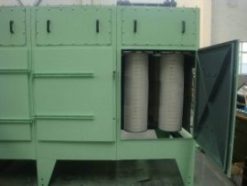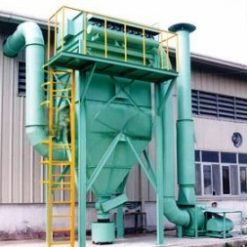


Cyclone Dust Collection System
The Cyclone Dust Collector is a method of separating dust particles from an air stream using a cyclonic vortex and collecting the dust in a hopper at the bottom of the cyclone.
In a plant-wide smoke and dust treatment system, the industrial Cyclone dust collection system can be coordinated with other central dust processing systems. In this configuration, the Cyclone acts as a pre-treatment stage, helping to remove large dust particles (visible to the naked eye) and withstand high temperatures at the input, thereby minimizing the volume of coarse dust before the air stream reaches the central processing system.
Operating Principle of Cyclone Dust Collection
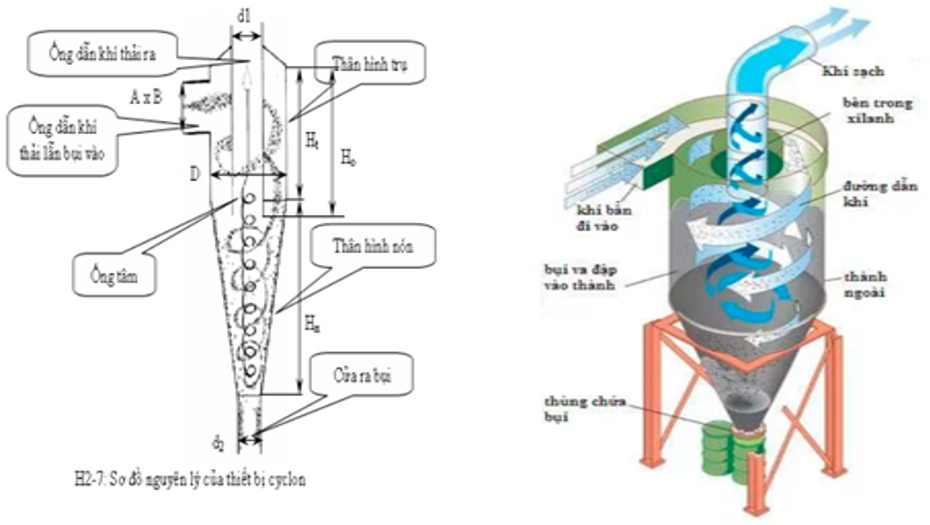
First, a centrifugal fan operates to create powerful suction, collecting the dust-laden air stream and pulling it into the system through air inlets and ducts. The dust-laden air enters tangentially to the cylinder, moving spirally due to the centrifugal force. The air stream hits the cone and is forced back upward, continuing its circular motion within the cylinder. Under the effect of centrifugal force, dust particles strike the inner walls of the device, lose their inertia and kinetic energy, separate from the air stream, and fall to the bottom.
Clean air exits through the clean air exhaust pipe, while the dust is collected at the bottom of the system. At the base of the hopper, a rotary valve is positioned to continuously transport the dust to a collection bin for proper processing.
System Structure
Typically, each unit designs and installs different cyclone systems. However, they generally share the following basic components:
- Tangential air inlet: A fixed duct positioned tangentially to the cylinder. The angle is calculated to ensure the formation of the most effective vortex within the cylinder body.
- Cyclone body: The area where dust is separated from the air stream via centrifugal force generated by the vortex. The body is usually constructed from materials with high wear resistance. Due to centrifugal force, dust hits the wall, loses kinetic energy, and falls downward.
- Hopper: Used to collect dust after it loses kinetic energy and falls.
- Rotary valve: Discharges separated dust from the hopper into a collection bin below.
- Centrifugal suction fan: Responsible for creating powerful suction to draw dust from the external environment into the system through ductwork.
- Clean air exhaust pipe: Allows filtered air to exit the system.
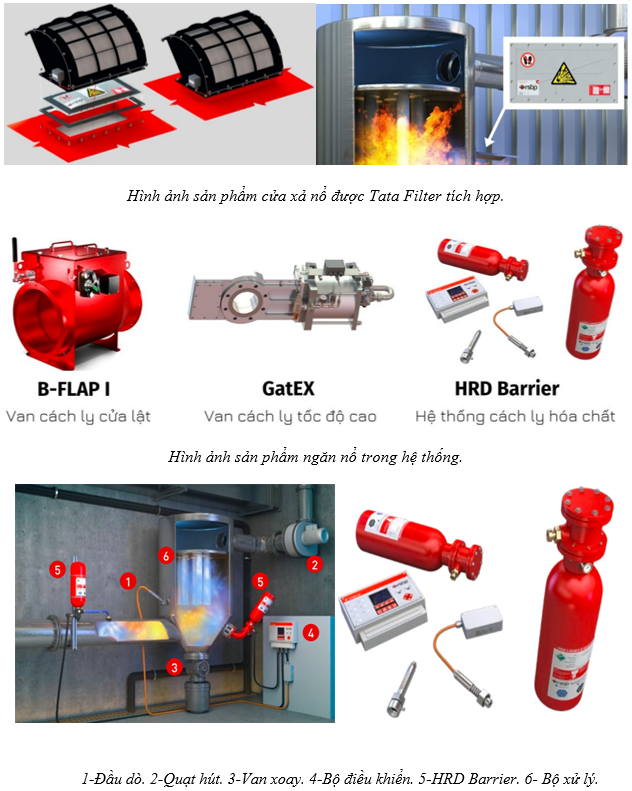
Additionally, the equipment is equipped with high-tech explosion-proof products to ensure safer operation in environments prone to fire and explosion risks.
Technical Specifications
Manufacturing materials: SS400 steel, Stainless steel.
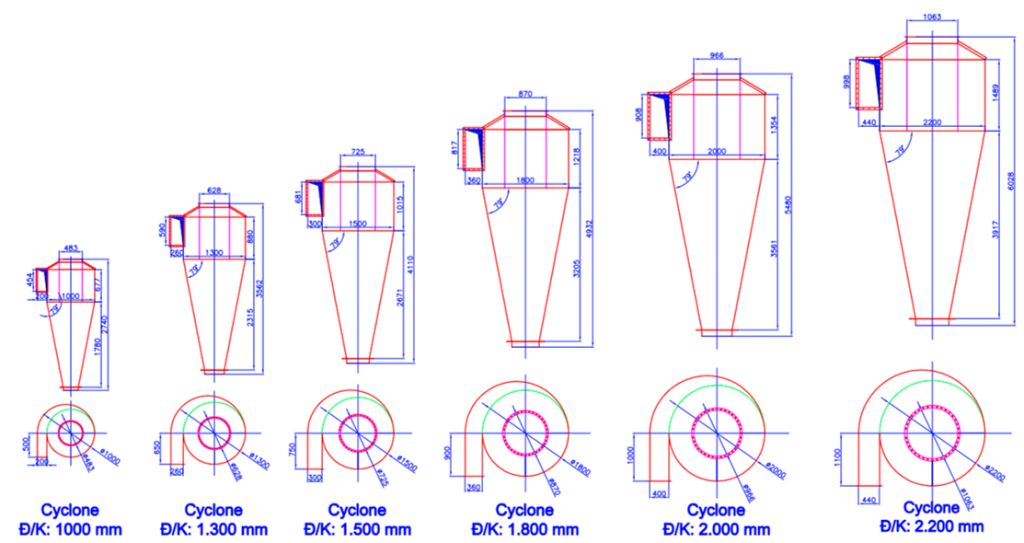
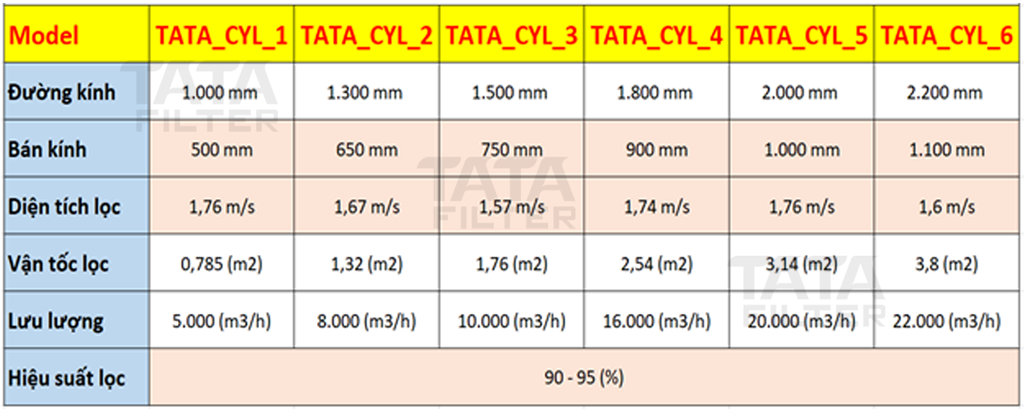
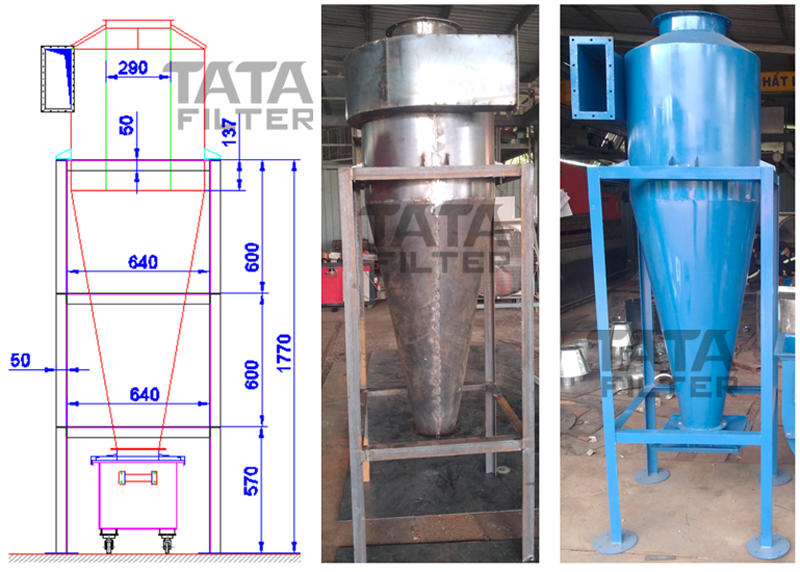
Cyclone dimensions depend on the capacity and flow rate of each specific project.
Cyclone lines designed by TATA FILTRATION feature the following specifications:
Applications of the Cyclone Dust Collection System
The industrial Cyclone system is applied to collect dust and particles (including corrosive, abrasive, sticky, and explosive dust) in various production processes: woodworking, sawmills & sanding, glass, paper & pulp production, cement, metallurgy, mineral mining, coke & petroleum, animal/poultry feed processing, food industry, chemical fertilizer production, etc.
Contact Tan Thanh
- Consulting and designing dust treatment and material recovery systems in industrial factories, surveying dust emission points and proposing solutions, calculating optimal airflow and capacity.
- Designing and constructing complete baghouse systems, installed in modules for seamless operational connectivity.
- Designing, constructing, renovating, and replacing suction hood systems, piping, exhaust fans, and flue pipes.
- Equipment solutions: filter bags, pulse valves, control boards, air tanks, piping, fan systems, suction hoods, differential pressure gauges, vibrators, fire/explosion protection devices, rotary valves, etc.
- Consulting on filter materials, manufacturing filter bags and cages to replace imports, and providing maintenance planning for each factory.
With the motto: “Technically correct, Competitive, On-schedule, Professional service”, we strive to achieve long-term satisfaction and trust from our Customers.
Consulting Hotline: 0901 858 686
Nguyen Phuoc Thuan. Phone: 0917 531 007. Email: kelvin@tatafilter.com
Pham Thanh Binh. Phone: 0919 823 239. Email: thanhbinh@tatafilter.com
Note: Please contact our hotline for customized advice. Any reproduction of content or images requires written consent from Tan Thanh Industrial Filter Company.
References
NEWS: