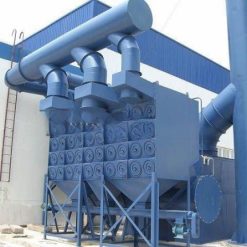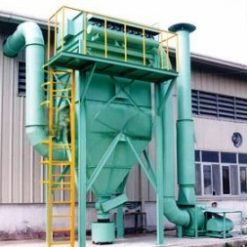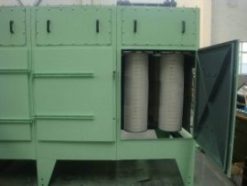

Wet Dust Collection System
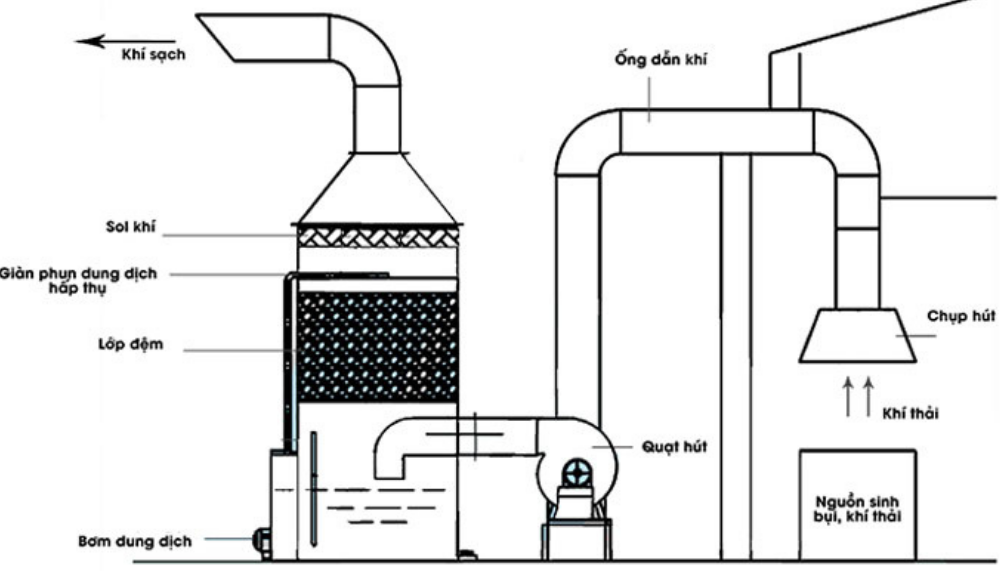
The wet scrubbing process is a simple and highly effective method for dust treatment, based on the mechanism of using a centrifugal fan to draw dust-laden air into contact with a suitable liquid, depending on the nature of the exhaust gas.
Operating Principle
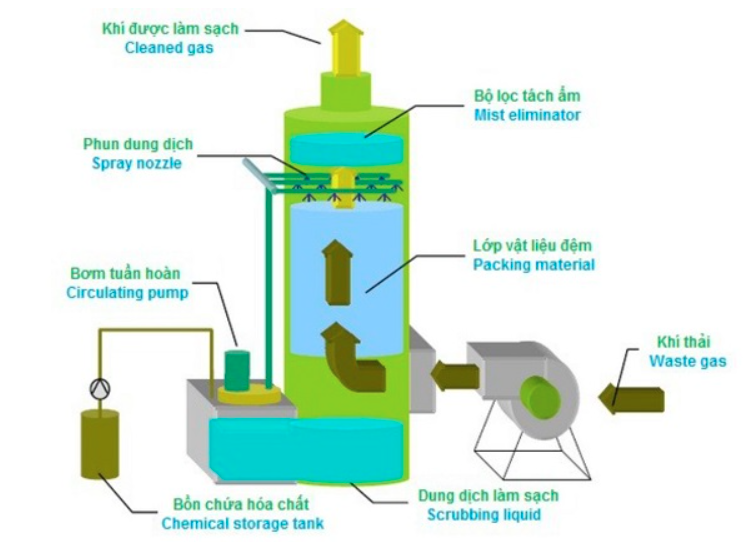
– A centrifugal fan draws the dust-laden air stream into contact with a liquid, typically water or chemicals depending on the nature of the exhaust gas. Small dust particles, exhaust gases, and toxic gases in the emission are wetted, separated from the air stream, and collected in a settling tank, while clean air passes through.
– Since dust particles have smaller size and weight than water molecules, they are trapped and separated from the air stream in the form of sludge.
– This dust treatment method is applied to small and ultra-fine dust, with particles larger than 3.5 micrometers (µm).
– Wet dust treatment is a highly efficient method capable of removing small, fine, and minute dust particles from the air.
– In addition to dust collection, these systems can also treat certain gaseous pollutants such as NOx and SO2, and are used to reduce the temperature of exhaust gas before releasing it into the environment.
System Structure
Common absorption devices include absorption towers made of 304 stainless steel, powder-coated steel, or plastic, spray systems (absorbent solution to scrub the gas), and packing layers (with adsorbent materials).
Depending on the design, the system may have a single-stage or multi-stage scrubbing configuration.
The purpose of the tower is to reduce dust, odors, smoke, toxic gases, or to cool the gas to reduce the load on downstream electrostatic precipitators or ozone deodorization systems. The absorption process occurs inside the tower, where molecules, atoms, or ions are diffused and pass through the interface into the liquid phase.
The absorbent solution can settle dust particles as small as 0.1µm, absorb toxic substances, turn black smoke into white, or eliminate white smoke completely, with cleaning efficiency reaching over 90%. It is widely used in incinerators, autoclaves, furnaces, boilers, coal, wood, diesel exhaust, ash, SOx, NOx, Cox, or substances such as Ca(OH)2, NaOH, etc.
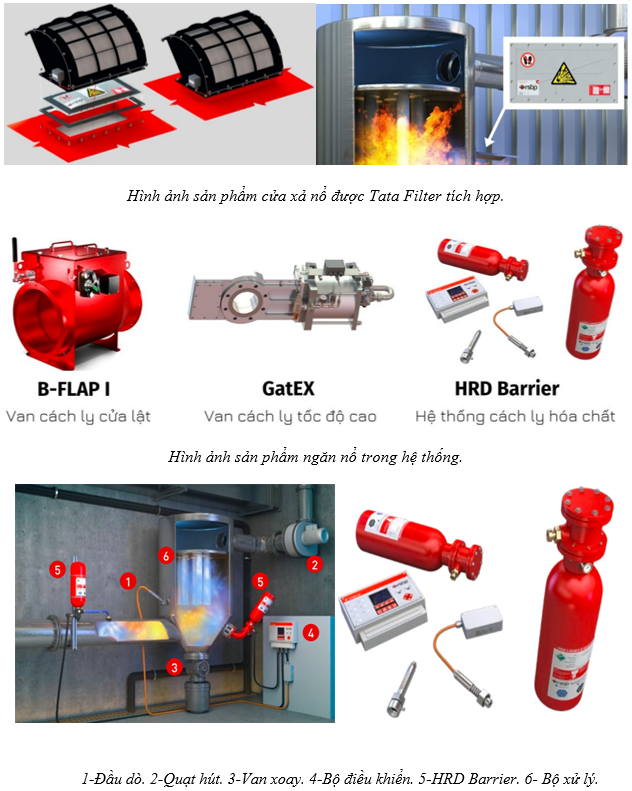
Additionally, the dust collection system is equipped with integrated high-tech explosion-proof products for safer operation in environments prone to fire and explosion risks.
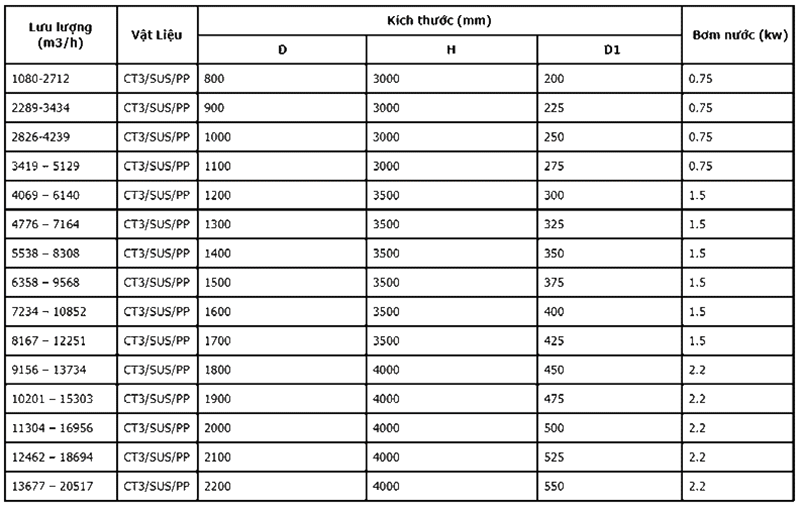
Technical Specifications
For each project requirement, Tan Thanh Company calculates the technical parameters and provides appropriate treatment solutions to ensure efficiency and compliance with the standards of the Ministry of Natural Resources and Environment.
Effective types of wet dust collection equipment
Spray chamber or empty gas washing tank
– Principle: Water is sprayed from above, and the gas stream is guided from below. It is also possible to spray water from four sides and lead the gas horizontally. When the dust-laden exhaust gas contacts the water droplets, dust particles are trapped and discharged from the device as sludge.
– Application: Used when the inlet velocity is low (0.6 – 1.2 m/s), and the equipment size is large. Used to filter coarse dust and simultaneously cool the exhaust gas. Used as a primary filter stage to reduce initial dust concentration before entering an electrostatic precipitator.
Packed bed scrubber (Wet scrubber)
– Principle: Packing material is wetted by water; the gas stream is directed upward or horizontally through the packing layer. When the dust-laden exhaust gas contacts the wetted surface of the packing, dust particles are trapped on the material surface and then washed away as sludge.
– Application: Required for fine dust filtration with relatively high efficiency. Combines dust filtration and toxic gas removal, especially for flammable gases/vapors present in the exhaust. Allows operation at high gas velocities (up to 10 m/s).
– Compact equipment size. Efficiency reaches 90% for dust particles > 2 μm.
Bubble plate column (Scrubber)
– Principle: Water is supplied to a perforated plate to maintain a suitable layer of water. The gas stream flows upward through the perforated plate, causing the water to bubble. Dust in the air contacts the surface of the water bubbles, is trapped, and flows down with the water into the collection tank.
– Application: Capable of filtering dust sized 5 μm or larger with relatively high efficiency. Applicable for wettable dust.
Mobile spherical bed scrubber
– Principle: The gas stream flows upward through wetted spherical particles that move freely within the gas-water mixture. Dust particles adhere to the water layer on the spheres and are trapped. When the spheres collide and rub against each other, they self-clean the accumulated dust layer.
– Application: Filtration efficiency can reach 99% for dust particles >= 2 μm. Allows gas velocities in the range of 5 – 6 m/s.
Inertial impact wet dust collector
– Principle: Water and dust-laden exhaust gas come into contact through the impact of the gas stream onto the water surface. Subsequently, the gas-water mixture maneuvers through gaps, forming fine water droplets in the gas stream. Due to inertial impact, dust particles are trapped in the water, and clean air is released.
– Application: Widely used in the metallurgical industry to filter common dust, sticky dust, and dust prone to fire or explosion. Relatively high efficiency for particles above 3-5 μm.
– The device self-circulates water and replenishes it without the need for high-pressure pumps. The inlet velocity must reach 15 m/s.
Wet Cyclone
– Principle: Uses centrifugal force to separate dust from the gas stream, similar to a dry cyclone. However, this device sprays water inside to form a film on the inner wall of the cyclone; once dust touches the wall, it cannot bounce back into the air stream, significantly increasing filtration efficiency.
Venturi scrubber
– Principle: Dust-laden exhaust gas passes through a venturi tube, then the gas moves spirally in the cylindrical body and exits. A water nozzle is installed at the venturi throat; as the exhaust gas passes at high velocity, it entrains water, creating fine droplets. Dust particles impact the water droplets inertially and are trapped. As the water droplets carrying dust spin in the cylindrical body, they are pushed to the wall and slide down the discharge pipe.
– Application: Capable of removing 100% of dust particles larger than 5 μm, and 97.9% of particles with a diameter of 1 μm.
Applications
There are many methods for dust and exhaust gas treatment, each applied in specific fields. The wet method is typically used in the following industries:
– Dust and exhaust gas treatment for emission control stations.
– Treatment of chlorine gas leaks.
– Exhaust gas treatment in boilers, casting furnaces, and metallurgy.
– Exhaust gas treatment in chemical production.
– Acid vapor treatment in metal plating, pickling, and powder coating lines.
Contact Tan Thanh
- Consulting and designing dust treatment systems, recovering dust materials in industrial factories, surveying dust emission points and treatment solutions, calculating optimal airflow and capacity for dust recovery systems.
- Designing and constructing entire baghouse systems, installing in modules to ensure factory operational connectivity.
- Designing, constructing, renovating, and replacing suction hood systems, piping, exhaust fans, and flue pipes.
- Equipment solutions: filter bags, pulse valves, valve control circuits, compressed air tanks and piping, fan systems, suction hoods, exhaust piping, differential pressure gauges, vibrators, fire/explosion protection devices, rotary valves, etc.
- Consulting on filter materials, manufacturing filter bags, and filter cages to replace imported products; maintenance planning for each factory.
With the motto: “Technically correct, Competitive, On-schedule, Professional service”, we strive to achieve long-term satisfaction and trust from our Customers.
Consulting Hotline: 0901 858 686
Nguyen Phuoc Thuan. Phone: 0917 531 007. Email: kelvin@tatafilter.com
Pham Thanh Binh. Phone: 0919823239. Email: thanhbinh@tatafilter.com
Note: Please contact the hotline for suitable advice. Any reproduction of content or images requires written consent from Tan Thanh Industrial Filter Company.
References
NEWS: