
Cyclone Dust Collection System Combined with Filter Bags
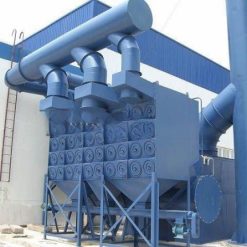
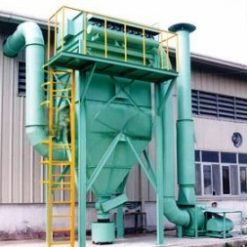
The Cyclone dust collection system combined with filter bags is a dust treatment system in a production line, where the Cyclone (1) acts as a pre-treatment before the fabric bag dust filter system, helping to remove large, high-temperature coarse dust particles from the air stream right from the intake, reducing the amount of coarse dust. Then, the air stream containing finer dust will continue to be drawn into the Baghouse dust filter system (2), treating it to return clean air to the normal air environment.
Operating principle of Cyclone system combined filter bags
The Cyclone dust collection system helps separate coarse and heavy dust particles, sticky or high-temperature dust, by air vortexes causing them to fall into the hopper and easily collect dust at the bottom of the Cyclone, reducing the amount of coarse dust before this air stream is further treated in the fabric bag dust filter system.
Further reference: Cyclone dust collection system
In this combined system, the centrifugal fan creates a very strong suction force from behind the fabric bag filter system, drawing the dust-laden air from the pipes into the Cyclone pre-treatment system to separate coarse dust, then the finer dust-laden air continues to be drawn into the fabric bag dust filter system, and finally, the clean air is drawn into the exhaust pipe to be discharged into the environment.
During the dust treatment process with fabric bags, clean air passes through the filter device, up to the clean chamber, and returns to the normal air environment, while dust is retained on the surface of the filter devices. The thicker the fine dust layer on the filter bag, the higher the resistance of the filter device, the lower the air permeability (Air-to-cloth rate), and the dust will be continuously shaken off by various methods such as mechanical shaking, reverse pressure, or high-pressure compressed air pulses.
The dust shaken off the surface of the bag will fall into the hopper below the filter chamber of the baghouse, transported through the discharge and transport system at the bottom of the dust filter (including rotary valves, screw conveyors, drag chains, etc.) to be collected for recycling or disposal.
Dust Filtration Efficiency: up to 99.8%.
Further reference:
Negative Pressure Filter Bag Dust Collection System
Modular Baghouse Dust Collection System
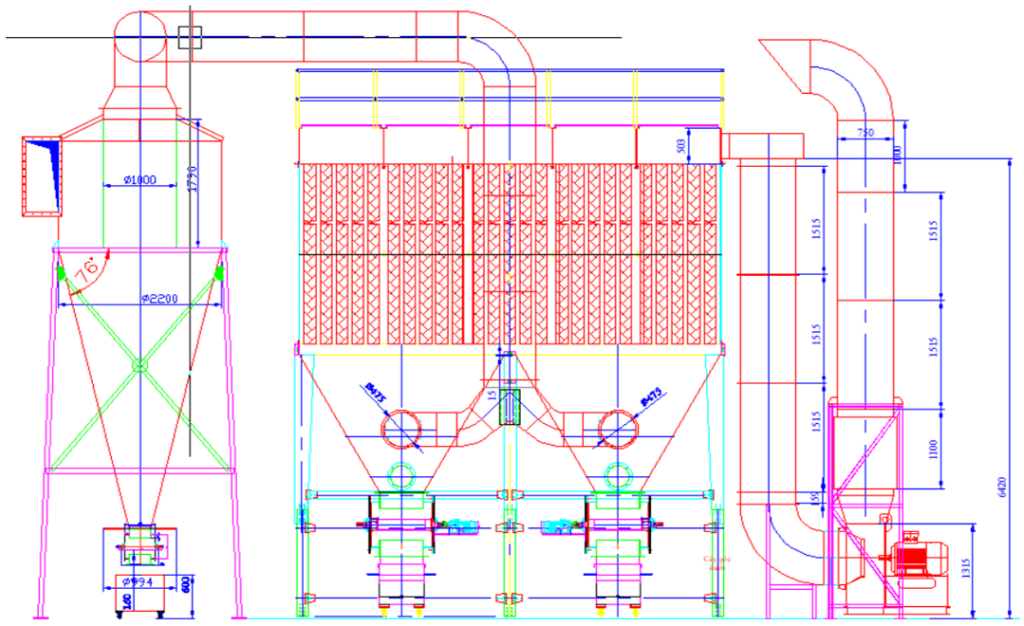
System structure of Cyclone dust collection system
Depending on the capacity and dust concentration, the design units of the Cyclone combined with fabric bag dust filter system will vary. However, there are still basic structures as follows:
• The suction fan is designed by TATA FILTER according to separate standards, with high efficiency, diverse models, and low noise.
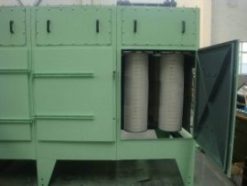
• The central dust filter and treatment unit includes fabric bags made from genuine materials, with clear CO and CQ origins, and the internal filter frames are processed according to industrial standards.
• The hopper collects dust shaken off from the filter bag unit, below which rotary valves, screw conveyors, drag chains, or material handling fans are used to transport dust to the centralized treatment or reuse area.
• The system of valves and circuits to control the shaking of dust adhering to the surface of the fabric bags.
• The electrical control system for the entire system with multiple operating modes (Fan, rotary valve, control circuit for dust shaking valves, etc.).
• The hood and piping system to draw smoke, dust, and pollutants to the treatment unit.
• The Cyclone is where dust is separated from the air stream by centrifugal force through the formed vortexes. The cylindrical body is usually made of high-wear-resistant materials. Due to the impact of centrifugal force, dust hits the cylindrical body, loses kinetic energy, and falls below.
• The rotary valve discharges dust when the dust is filtered and separated, falling below through the hopper. Dust will be discharged outside by the rotary valve to be stored in the container below.
• The clean air outlet where clean air is discharged outside through the exhaust pipe.
Explosion Suppression System
The equipment is also equipped with high-tech explosion suppression products to ensure safer operation in environments prone to explosions.
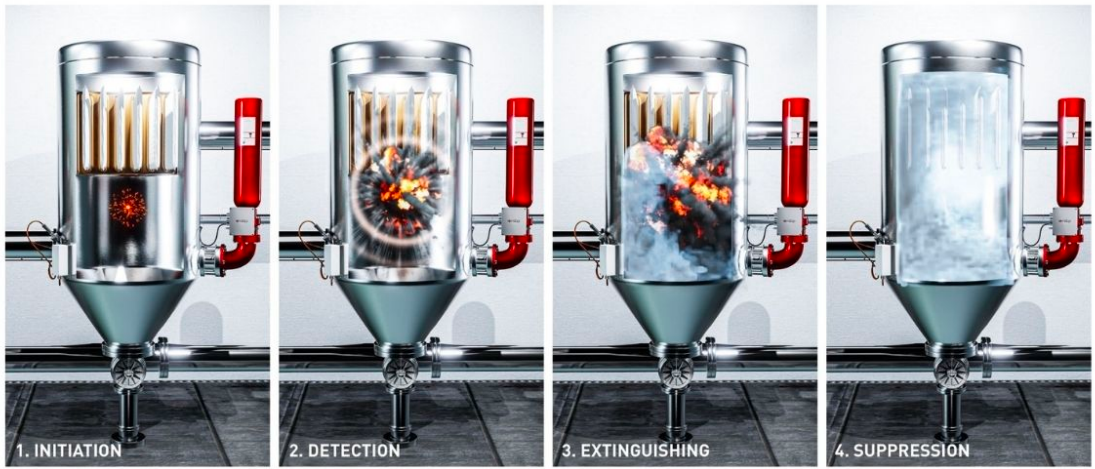
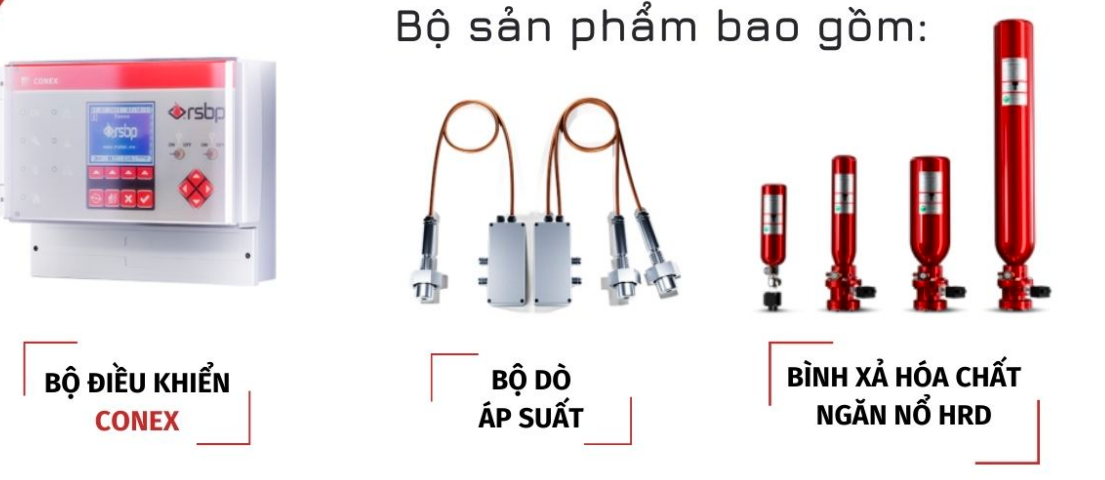
- The explosion suppression system detects the initial stage of an explosion inside the equipment and then prevents the fire from spreading.
- The explosion suppression system eliminates damage to technological equipment, protecting human health and life.
- The explosion suppression system operates on the principle of highly sensitive detectors, which can detect a newly occurring explosion in milliseconds. The controller sends a signal to open the valves. The pressure of the fire extinguisher will push the special telescopic nozzles, which will ensure the effective dispersion of the fire extinguisher into the entire protected area. Thus the explosion pressure is controlled and its side effects are minimized.
- In 0.001 seconds, the explosion suppression system can:
– Detect the pressure build-up leading to an explosion.
– Discharge the explosion suppression chemical into the space before the increasing explosion pressure.
– Remove the heat from the burning fire.
– Lower the temperature below the point where no explosion occurs.
– Extinguish unburned elements and prevent heat transfer.
– Protect property and human life.
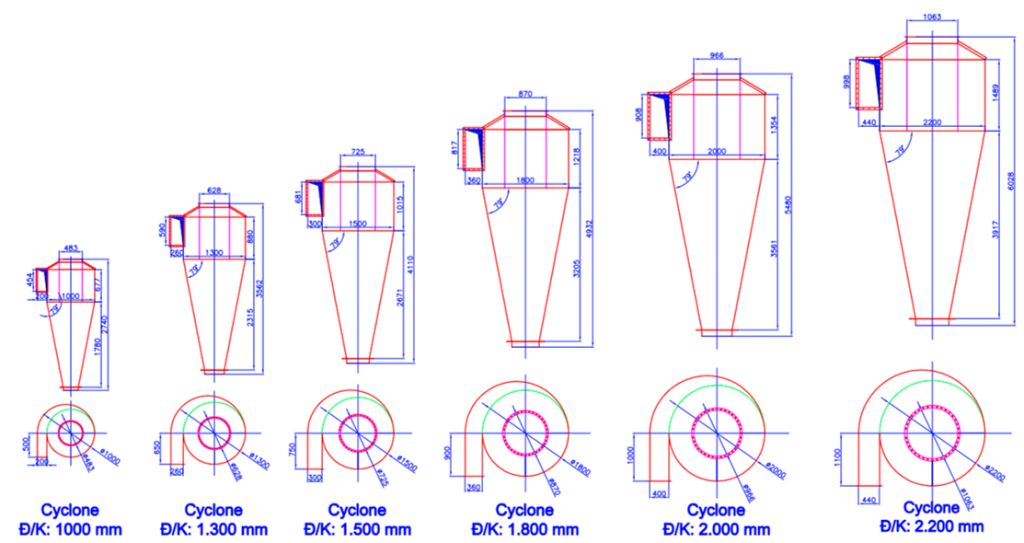
Technical specifications of Cyclone
- Material: SS400 steel, stainless steel.
- The size of the Cyclone dust collector combined with filter bags dust collector depends on the capacity and flow rate of each project, calculated and designed by TATA FILTER to achieve the highest filtration efficiency.
Applications
Widely used to collect dust and particles in production processes: wood, sanding dust, ceramics, porcelain, composite, cement, mineral extraction, animal feed processing, fertilizer production, food, etc.
Tan Thanh Contact
- Consulting, designing dust treatment systems, material dust recovery in industrial production plants, surveying dust generation points and solutions for dispersed dust treatment, calculating optimal flow and capacity for the dust recovery system.
- Designing and constructing the entire baghouse system, installing modules, ensuring the operational connectivity of the plant.
- Designing, constructing, renovating, and replacing hood systems, ducts, exhaust fans, and exhaust pipes.
- Equipment solutions: dust filter bags, dust shaking valves, valve control circuits, air tanks and piping systems, fans, hoods, and exhaust ducts, differential pressure gauges, vibrating hammers, explosion suppression safety devices, rotary valves, etc.
- Consulting on filter materials, producing dust filter bags, filter bag cages, to replace imported goods, planning reserves and maintenance for each plant.
With the motto: “Right technique, Competition, Timely schedule, Professional service” we strive to bring satisfaction and long-term trust to customers.
Hotline: 0901 858 686
Kelvin Nguyen. Phone: (+84) 917 531 007. Email: kelvin@tatafilter.com
Nguyen Minh Hoang. Phone: (+84) 978 017 447. Email: minhhoang@tatafilter.com
Note: Please contact us directly for appropriate advice. Any form of copying content or images must have written consent from Tan Thanh Industrial Filter Company.
SEE MORE…
TECHNICAL SUPPORT:
- Cách tự kiểm tra túi lọc bụi để chuẩn bị thay thế (How to check the dust filter bag yourself to prepare for replacement)
- Sử dụng dịch vụ kiểm tra, dò tìm túi lọc bị thủng (thoát bụi) (Use the service to check and detect punctured filter bags)
- Hệ lọc bụi có thể cải tiến, nâng cấp hay không? (Can the dust filter system be improved or upgraded?)
- Phủ keo đường may túi lọc bụi – tăng cường khả năng lọc bụi mịn. Liên hệ
NEWS:
- FILTECH 2024 – Hợp tác với Particle Technology Limited và SGS
- Tham dự Triển lãm quốc tế ENTECH 2023
- Hợp tác cùng GUTSCHE LYDALL (Cooperates with GUTSCHE LYDALL)
- Distributor Certification from GUTSCHE ALKEGEN
- AOG Agent Certification
- Certification of ISO 9001:2015
CASE STUDIES:
Tại sao túi lọc bụi liên tục bị hư hỏng khi vận hành? (Why are dust filter bags constantly damaged during operation?)